
More Romanesque Lions
Saint-Pierre, Varen

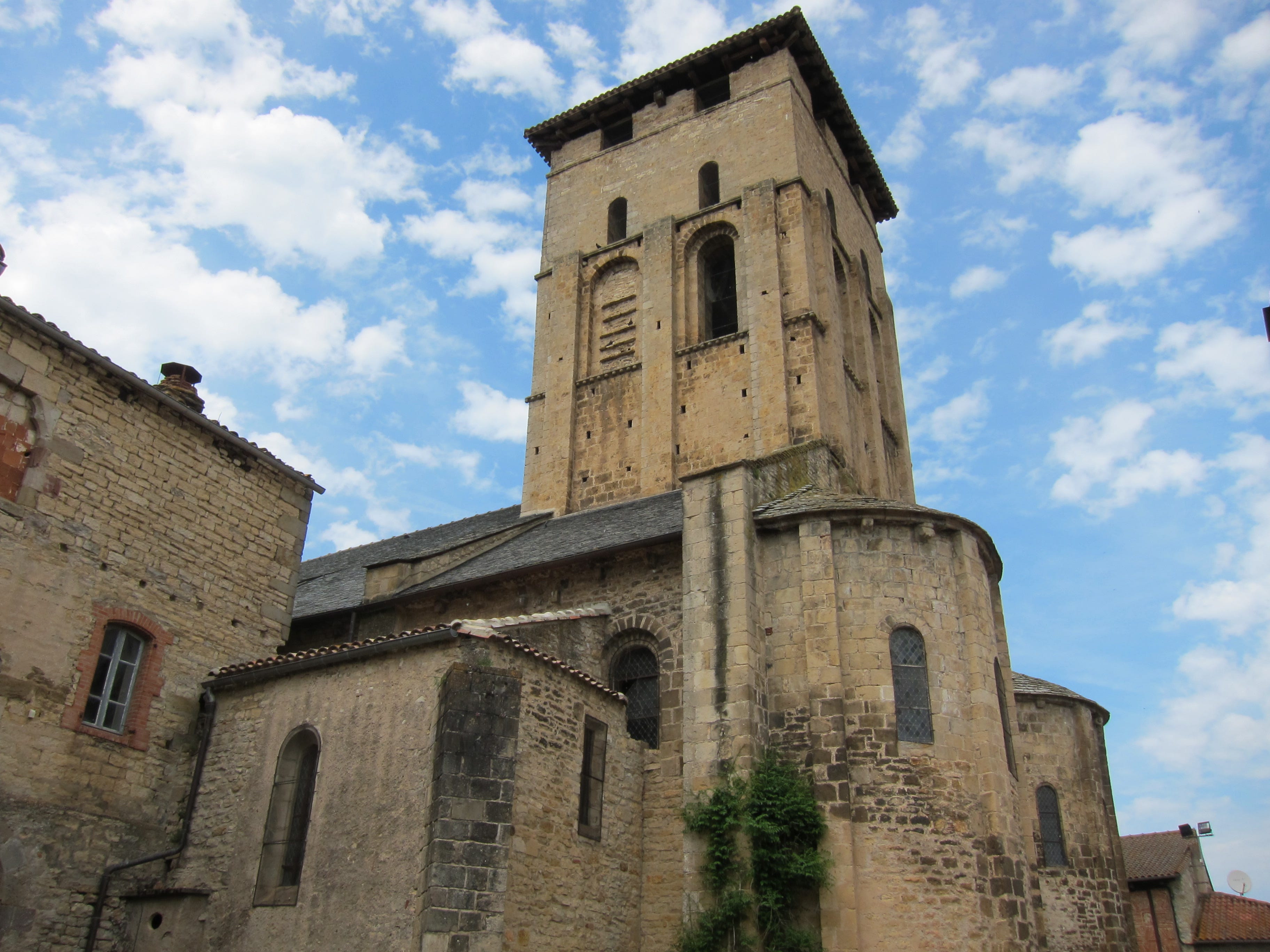
With reference to my previous post on the Romanesque archaeology conference in Toulouse and Wilfried Keil’s discussion of Daniel in the lions’ den,1 I went to look again at a Romanesque sculpture in Varen village on the banks of the Aveyron river, close to where I live in southern France. Varen is a very small village with an enormous Romanesque church, Saint-Pierre.
Inside the church, if you squeeze through a gap behind the altar, you find this painted sculpture of Daniel and lions, which dates to the eleventh century.2 Daniel’s arms and hands are raised in the posture of prayer. According to the label in the church, the lions are depicted head down to show they have been defeated by Daniel’s prayers.
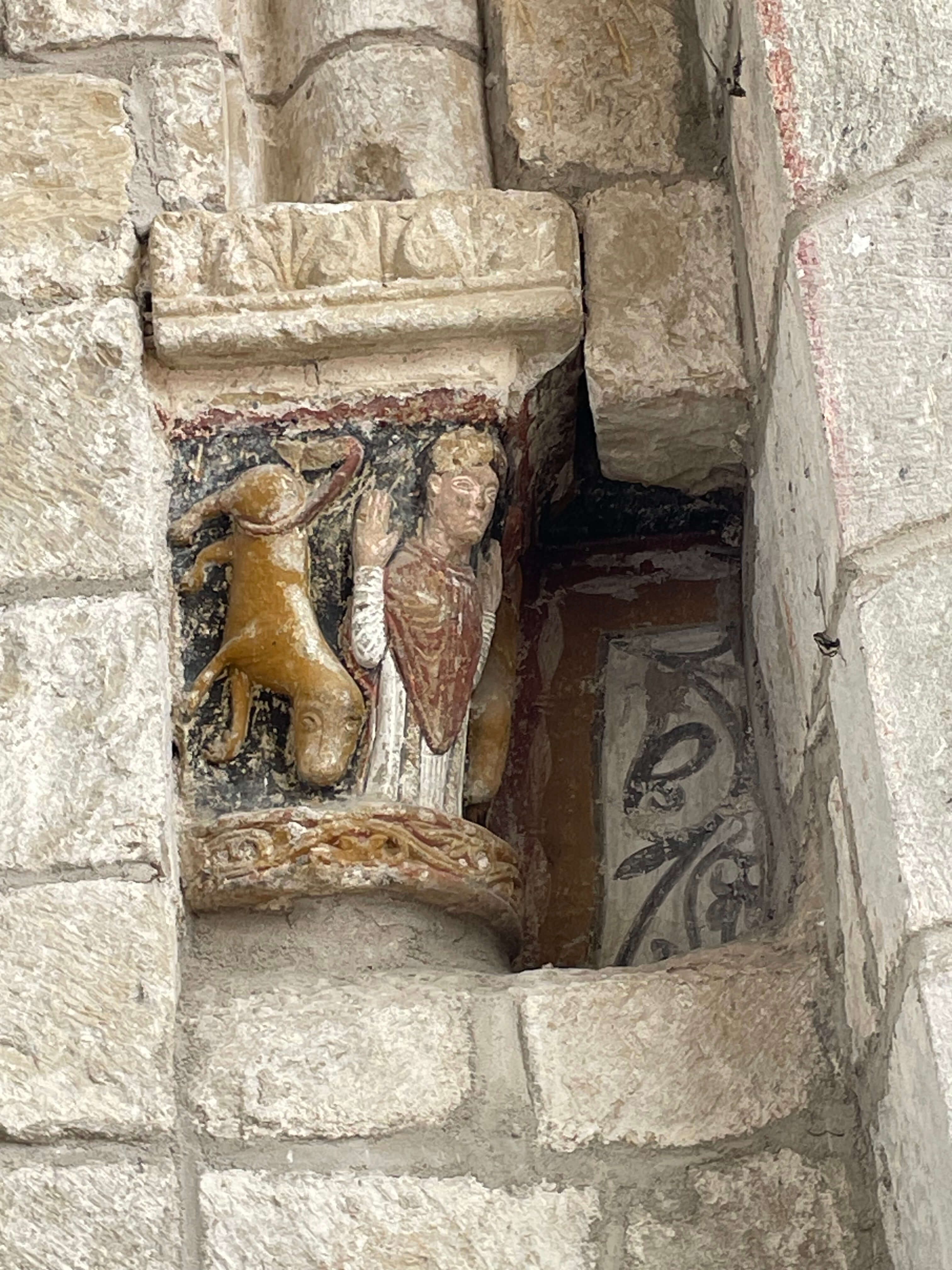
The sculpture is so oddly placed because there were originally two adjacent churches and this capital is part of the doorway to Saint-Serge church, now demolished. The survival of the sculpture has a fascinating history.
A priory existed in Varen from the ninth century, founded by Count Géraud of Aurillac (855–918), when the village was part of the medieval county of Rouergue. Around 972, Garsinde, countess of Toulouse, bequeathed a legacy to the priory. Around 1060–1070, the vast proportions of the church of Saint-Pierre were achieved by vaulting an earlier structure and a second church, Saint-Serge, was built alongside it to house the important relic of Saint Sergius’s body. The scale of these structures in such a small community reveals the existence of a pilgrimage centred around the relic of the saint.3
From the fourteenth to the sixteenth century, the villagers and their churches endured the Hundred Years War and the War of Religions. In 1758, the church of Saint-Serge collapsed and had to be demolished. Its stones were used in village buildings. Towards the end of the eighteenth century, Saint-Pierre was stripped of its paving stones to produce saltpetre, which was needed by the armies fighting against the First Coalition.
Only a few traces of the Romanesque church of Saint-Serge remain, including several capitals that topped the church’s columns. Two capitals were repurposed as fonts near the north entrance. One is covered with a dense network of interlacing patterns and palmettes. This interlacing decoration was inherited from Carolingian art.


The decoration of the second repurposed capital is a large, interlaced knot, made of two crossed ribbons within a circle, giving rise to the palmettes. This motif, resembling a belt buckle, also characterises several capitals in Saint-Geraud d’Aurillac and Sainte-Foy de Conques.
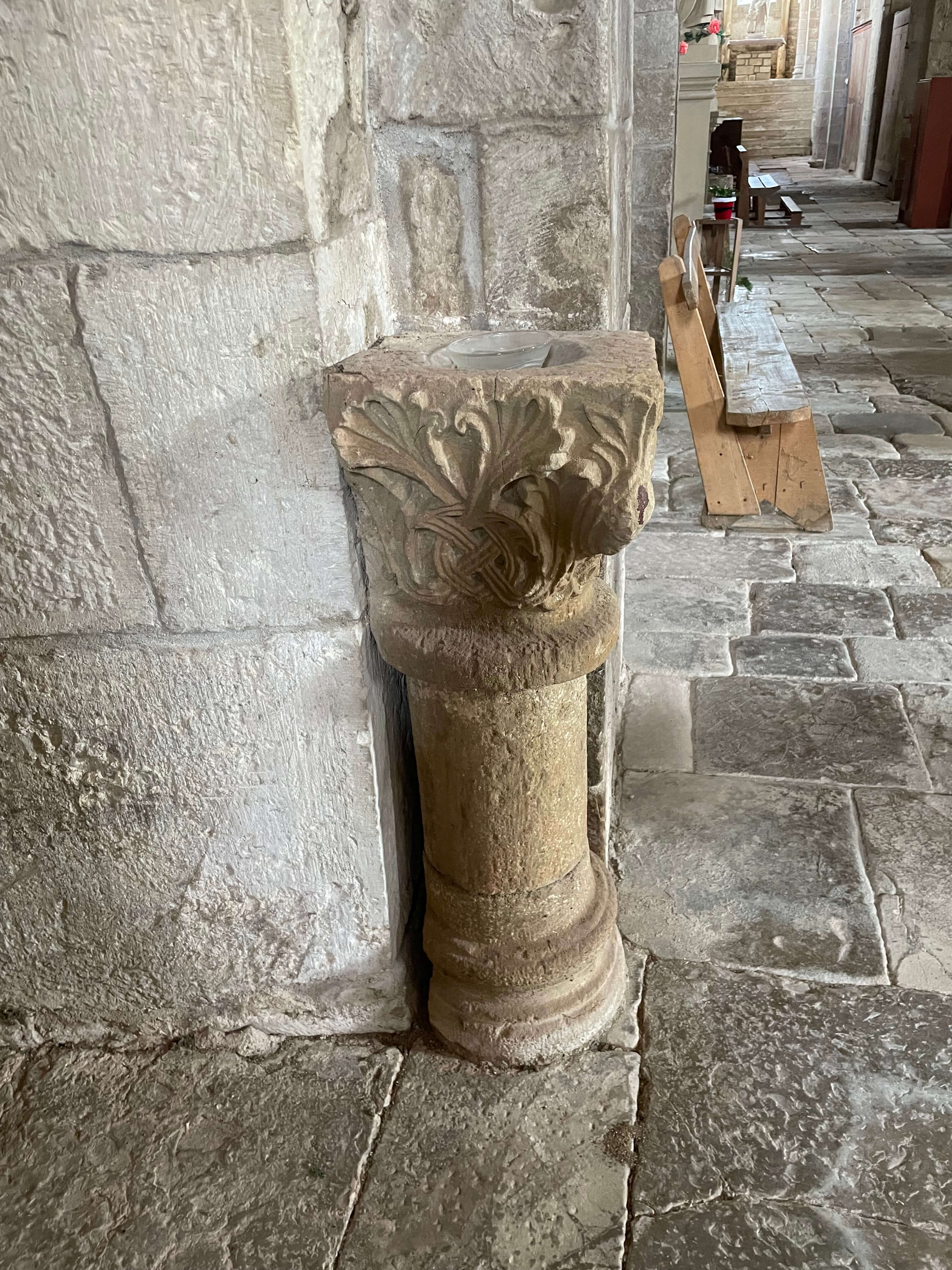
The large, flat palmettes with leaflets fanning out and meeting at the corner of the capital first appeared around 1050 on the marble capitals of the altar of the (now lost) Romanesque cathedral at Rodez, which came from a workshop in Narbonne. One of these capitals is now in the Fenaille Museum in Rodez.4 It seems likely that the same stonemasons worked at all of these sites, including Varen.
In an article published in 1970, Jean-Claude Fau discussed the similarities of the surviving Romanesque interlaced style capitals in Varen with sculpture at Conques and Rodez Cathedral and influences from Elne and Catalonia.5 The three capitals remaining in place in the area of the Saint-Serge demolitions in Varen exhibit ‘cubic’ paneling which, in the southwest of France, usually coexists with interlacing ornamentation. The lower part of the capital is an inverted truncated cone, and the upper part is a cube. Two of these capitals are adorned with ‘foliate’ interlacing, that is, interwoven ribbons whose strands blossom into palmettes. And, on the abacus, there is an engraved frame, known as a ‘Carolingian cartouche’. On the left-hand capital, at the springing of the arch connecting the two churches, the interlacing gives way to a kind of embossing made of small, recessed lozenges, a motif sometimes described as ‘honeycombs’.
In his study of the Romanesque capitals at Varen, Fau describes how:
a fine set of four historiated capitals adorn the former Romanesque portal of the apse (which was walled up in the 16th century). On one of the two capitals now located inside the church, two angels with raised arms can be seen, quite similar to those on a capital in the north gallery of Sainte-Foy de Conques. On the other, Daniel, in the attitude of prayer, is flanked by two lions oddly depicted with their heads downwards. Outside, the northern capital shows Samson riding a lion, its jaws being pulled apart, and beside it, a griffin with a bird’s head. The scene on the fourth capital is found in several churches in the Rouergue region; it depicts Saint Michael trampling underfoot the serpent-bodied dragon he has just slain with a single blow of his lance. Not only the iconographic theme and style, but also certain details of the archangel’s costume are very reminiscent of a capital in the sacristy of Conques.
It’s helpful both in writing my novels set in the early Middle Ages in this region and in the biography I am writing about an eleventh-century Occitan countess, to be able to see first-hand some of the structures and art that surrounded the people of this time.
An Unruly of Archaeologists
Thanks to Andrew Parton for pointing the capital out to me. See my post on his medieval reenactment armoury https://traceywarr.substack.com/p/stumps-of-lances-with-silken-streamers
Jean-Claude Fau, ‘Les chapiteaux de Varen,’ Bulletin de la Société Archéologique de Tarn-et-Garonne, 1 Jan 1970, 11-23, https://gallica.bnf.fr/ark:/12148/bpt6k6533918z/f13.item
Wonderful article...thank you!