
Medieval Christmas
Christmas scenes and medieval recipes


In the run-up to Christmas, I’m posting a series of medieval Christmas scenes along with related medieval recipes. The scenes are extracts from my published novels. Below the scene, you will find a related medieval recipe and a historical note on the king of the bean and bumbulums.
Today’s extract is from Almodis: The Peaceweaver (Meanda Books, 2023), Chapter 21 Christmas 1040. Almodis, the protagonist, is based on a real woman who was countess of Toulouse from 1040-1053. Piers and Bernadette are her servants. She mentions Dia a few times, who is her Catalan troubadour. Pons is her second husband, the count of Toulouse. The Lord of Lusignan was her first husband.
Almodis: The Peaceweaver
Chapter 21, Christmas 1040
I dismount to rest my horse for a while and stand in pale green grass waving in a bitterly cold wind, looking toward the castle of Saint Gilles. We had to make slow progress here because of my condition. It is near Christmas, and the countryside is deep in snow. A dark red bush pushes up through the snow, looking like a bloodstain against the pure white. I feel the chill and damp through the soles of my boots. I turn my arms and hands over and over in the fat flakes of snow, smiling. Underneath my fur-lined hood, my hair hangs in a single plait down the back of my green tunic, and underneath the tunic is a canary yellow dress that shows through at the sleeves and at the slits on the sides. The sleeves of my yellow under-dress are so incredibly long and flared that they will sweep the floor when I walk into the hall of Saint Gilles to tell my lord I am carrying his heir.
I tuck my cold hands into my sleeves. There are knights on horses in the distance, in front of the castle. The sky is a mix of blue and dirty yellow; the sun is shining, but the temperature is freezing. The snow gives a peculiar quality to sounds, making them carry long distances. In the frigid air, we hear the voices of the knights, the snorting of their horses and the clanging of their weapons on the target. I stamp my feet and wish I had three pairs of hose on.
The castle of Saint Gilles stands on a huge granite rock that rises up out of the flatter land around it. The rock is grey, and the castle is grey, so that it seems to grow out of the rock. A crenellated wall runs around its four sides and six towers rear up above the wall and the battlements. It is not a regular square because it has been built following the contours of its rocky foundation. Clustering at its foot and climbing up toward it are small houses with red-tiled roofs and steep, cobbled streets with haphazard steps cut into them.
We remount and as we get nearer, I see the knights more clearly. They are wearing white padding and practising with a target and a spear, riding one at a time to try to hit it in the centre. I wave to them, and they wave back. I lead my party toward an arched stone bridge. There are many fishing birds on the river: slim and elegant black cormorants, white and swooping gulls, herons perching and occasionally taking off from rocks in the river on their slow, enormous wings. Slabs of ice float in the green water and ducks weave around them.
‘Imagine how cold those ducks’ feet are,’ says Bernadette.
Unseen fish splash and make circles on the river’s surface. Our horses’ shoes sound on the bridge and then we are over, in the stony town of Saint Gilles. We have to dismount again to climb up the steep streets, and ice and snow underfoot are treacherous. People stop and stare at us. The colours of their clothes are drab browns, greens, whites but also very bright colours: reds, yellows and blues. I smell a whiff of the fuller’s vats where sheep’s wool is pummelled in urine for hours, the ammonia drawing out the grease and making the wool soft. Perhaps some of these people are employed to stand up to their knees in these vats all day, treading the wool. I swallow, nauseous, and lean more heavily on Piers’ arm as he assists me up the slope. I am heavy with my child.
Women are carrying loaves of bread and pails of water, men carry bundles of firewood, children play on the steps of the houses with wooden toys, a cat shakes snow from its paw and blinks at me, smoke rises from the chimneys of the houses. We skirt around steaming piles of mule dung. Many of the doors are hung with circles of holly with bright red berries for the Christmas feast. There are deep drifts of snow on the street-corners and in patches on the roofs of the house and every now and then a chunk of snow slides from a roof onto the street below or once, unfortunately, down the back of Bernadette’s neck. ‘Ee-eek!’ she exclaims, and Piers and I laugh.
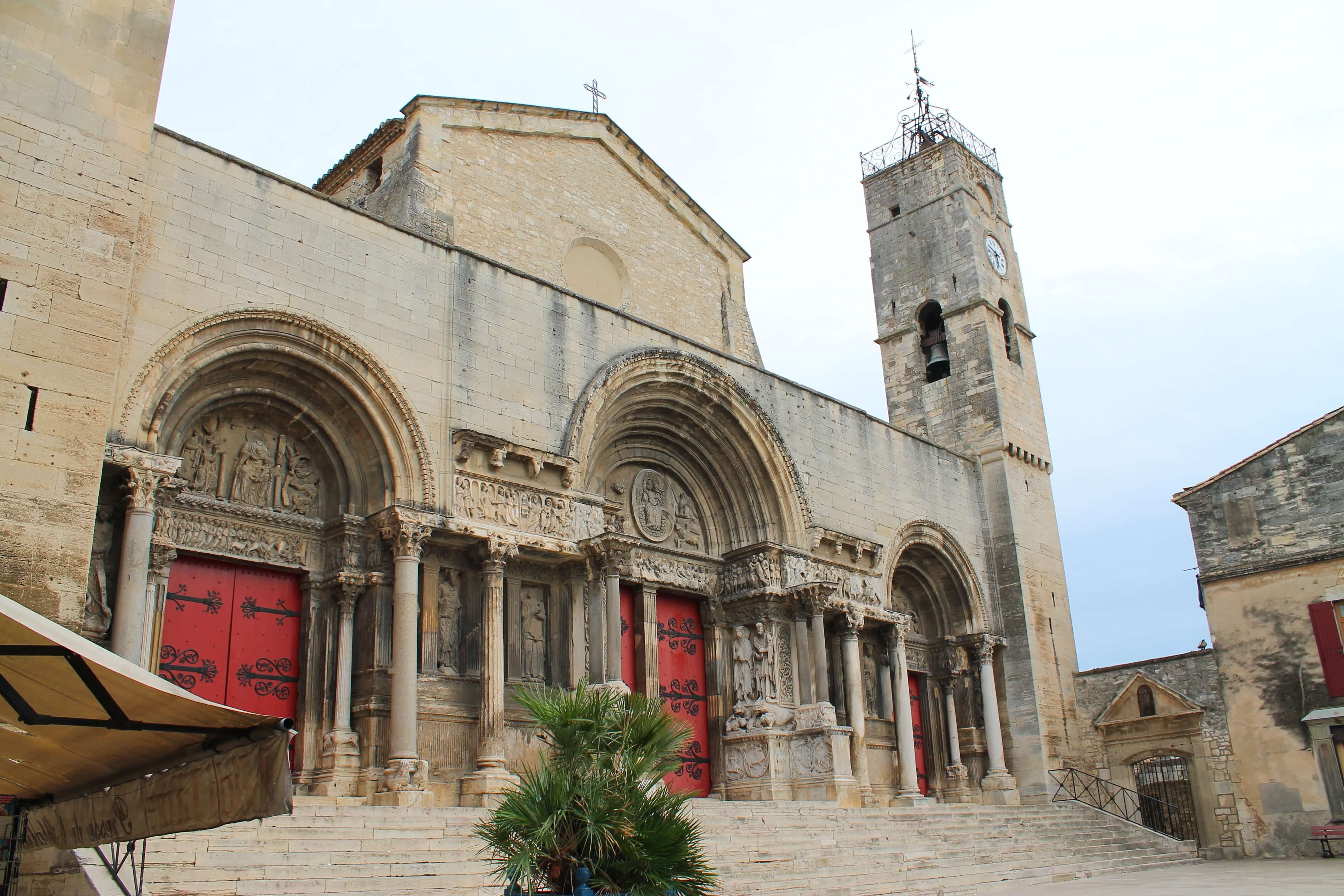
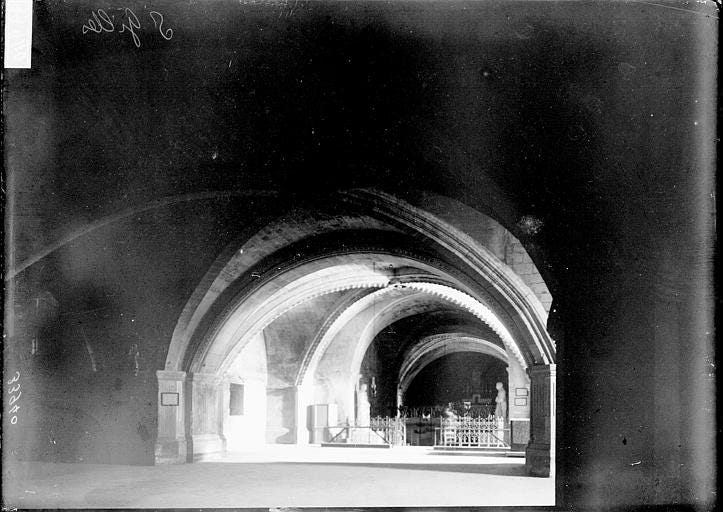
The wooden arched door in the massive stone wall of the castle is studded with metal knobs and bands. Inside this door is like being in yet another village as the castle walls enclose more stone buildings: the bakehouse, dairy, pigsty, dovecote, stables, and one large building. Piers leans hard on the giant door of the great hall. Inside, there are tapestries on the walls and the smell of rosemary rising from the rushes. Hanging everywhere is green ivy and the darker green of prickly holly and here and there the white berries of mistletoe. ‘Shut the door!’ someone yells and Piers turns and leans on the door behind us, closing it with a clang.
So I am come (but briefly I intend) to Saint Gilles, where Pons and I will entertain his nephew Bertrand for the Christmas feast. I take in the cavernous room in front of me: two extraordinarily long wooden tables with benches, a fire burning brightly, large shaggy dogs curled in front of the fire, people scattered, doing odd tasks: cleaning weapons, practising on instruments, cradling babies, spinning and sewing. At the far end of the hall, on the raised platform stretching across its width, sits Pons with Bertrand.
I register the looks on their faces as I glide up the hall toward them, my belly preceding me by quite some distance! After greetings and Pons’ joyful effusions and the much less sincere congratulations of his nephew, Bernadette hands me a glass of warm punch flavoured with citron and sweet syrup, and then I excuse myself and my unborn child for a short rest. Pons is anxious that I should be treated with the utmost care.
Bernadette takes me up to a small room above the hall, which has a window with two tall, pointed arches. She throws up the lid of a wooden chest that stands at the foot of the bed, rummaging in it. Eventually her head re-emerges, her cheeks pink, and she throws more fur quilts onto the bed. ‘I think these will do.’
‘So I shall birth the heir of Toulouse in this bed,’ I say.
‘Are you sure it’s a boy?’ says Bernadette.
‘Yes, Dia took two drops of my blood from my side and dropped them into spring water, and they sunk. Also, my right breast is bigger than my left, which Hippocrates said is a clear sign of a boy.’
There is a sudden clangour of bells from the church to pronounce the start of the Christmas feast. ‘The peasants are on holiday now for two weeks,’ exclaims Bernadette, looking like an excited child. ‘The best feast of the year!’
‘Perhaps we should rejoin the Christmas group then,’ I say, not wanting to curtail her fun just because I would avoid my lord, and in any case, I am hungry. Back downstairs, there is shouting near the door, which bursts open, giving entry to two men dragging what looks like a small tree toward the fireplace.
‘The yule log,’ says Bernadette, ‘that will burn through the whole holiday.’
With a great effort, swinging it a few times between them, the men throw the log onto the fire where it sends out sparks and heat. People are clapping and laughing, sitting down at the long trestle tables, which are full now with the whole household crammed into the hall, and there is a buzz of chatter and laughter and a great deal of staring at me.
The servants are handing round chunks of bread to everyone. ‘King of the Bean! King of the Bean!’ children chant, and I think with a pang of my own Lusignan children, left behind in Toulouse, playing with their Christmas toys with Dia instead of me.
‘This is a special Christmas game played here, my lady,’ Bernadette tells me, standing at my shoulder, ‘where the person who finds a small bean baked inside their bread will be crowned the king of the Christmas feast, so don’t swallow it if it’s inside yours.’
I take a bite of my bread, finding nothing, and look along the rows of faces to see who has the bean. Bernadette has seated herself just below the platform and I see that she is pushing her cheek out with her tongue, a comical expression on her face. She takes a small object from the tip of her tongue. ‘Oh!’ he says, looking at the large white bean on her fingertip.
‘It’s you!’ Piers yells, hoiking her to her feet, shouting, ‘Bernadette has the bean! Bernadette has the bean!’
Everyone stops talking to stare and one of the table servants places a silver plate crown on her head, laughing and bowing to her as he does so. We rise to our feet, lifting our tankards and glasses and yelling loudly together, ‘Hail King Bernadette, King of the Bean!’ Bernadette is obviously worried about keeping the wobbly crown on her head and has gone the colour of a beetroot.
We eat a thick vegetable soup, then chicken and roast boar, and finally cheese. Pons pokes and probes at his mouth with a wooden toothpick. ‘There’s another whole course in your teeth,’ he says, roving his tongue under and over his lips.
Musicians play on recorders, horns, trumpets, whistles, bells, and drums. Everyone listens in concentrated silence and claps wildly when they finish. Then come acrobats, who stand on each other’s shoulders, juggling and playing flutes and then, the professional farters.
‘These are my favourites’, says Pons, making me glad that Dia isn’t here.
The heat of the fire is making my face red and my head thick with sleepiness. I go and stand near the door to give gifts to the servants as they leave: parcels of food, clothing, ale and bundles of firewood.
Upstairs in my white nightgown, made from soft Egyptian cotton, and with a red woollen shawl draped around my shoulders, I lean from the arched window, gasping at the cold beauty of the night. Trees, hillside, everywhere is white with a dusting of snow, and the river is beginning to freeze over. Buildings shimmer with icicles. The cloud is white and so low it almost touches my nose. I shutter the window and turn to the huge bed, piled high with blankets and pillows. I expect the sheets to be freezing but find they are snug and warm. Bernadette has put a bedpan of hot water in to warm them. I slide the covered pan out, balancing it gingerly with its long handle, and set it carefully down on the floor.
Medieval Recipe
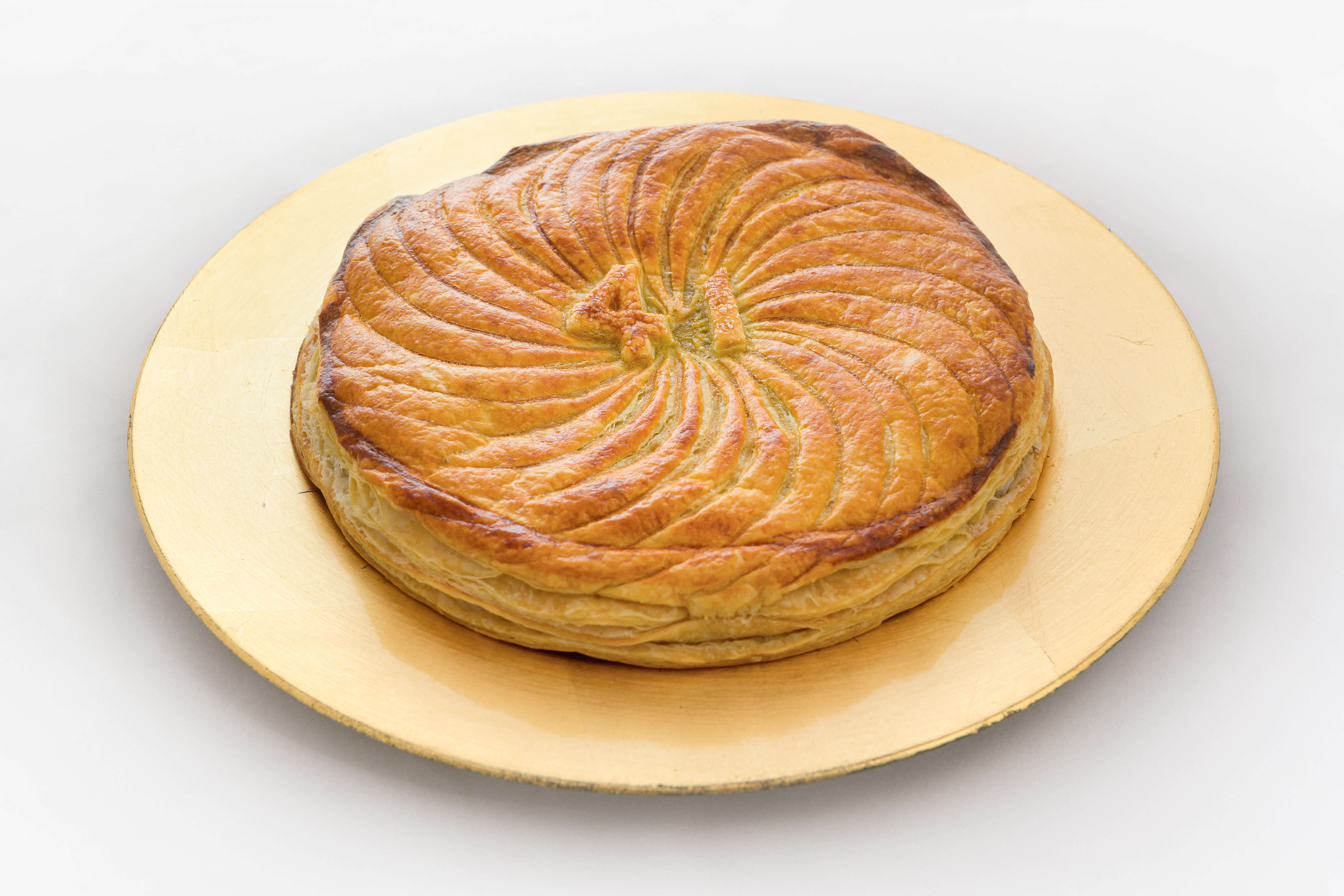
Dariole de Crème / Frangipane Tart
For the dough:
250g flour (plain unbleached wholegrain flour or chestnut flour would be closer to medieval flour than contemporary white flour)
125g butter
tablespoon of sugar (sugar was rare and expensive in the Middle Ages)
1 egg
pinch of salt
For the filling:
100g sugar
200g almond powder
4 eggs
50 cl crème fraiche
In a bowl, mix the flour, salt, sugar, add the egg and the softened butter in small cubes, mix with a fork then mix with a little water gradually with your fingertips. Knead quickly without insisting. Let the dough rest in the fridge for an hour.
Fill a pie mold with the dough. Press the edges well so that the dough sticks, prick the tart base and the edges with a fork. Cook in a hot oven for 10 minutes.
In a bowl, whisk the eggs and sugar until the mixture turns white. Incorporate the crème fraîche and the almond powder and mix until you obtain a smooth mixture. Pour the mixture onto the precooked dough.
Place in a moderate oven for 45 minutes. Cover with foil when it starts to brown.
According to Platine, a frangipane softens the chest, helps the kidneys and liver, increases generation and tempers the heat of urine.
This recipe is from Le Viandier de Taillevent. Taillevent was a self-taught master chef. In his very long career, he served four kings of France. The manuscript was probably commissioned by Charles V and modified throughout the 14th century. It was the most published of the European culinary books of the Middle Ages and included blancmanges and a subtle poultry and chestnut broth recipe from England.
Published in René Husson and Philippe Galmiche (2011) Recettes Médiévales, Saint-Affrique: Editions Fleurines.
Historical Note
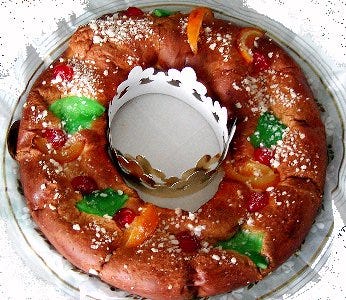
The ‘king cake’ or ‘three kings cake’ or ‘Twelfth Night cake’ celebrated Epiphany (6 January) at the end of the 12-day period of medieval Christmas feasting. The medieval version of the King Cake was a heavy egg-based, brioche-like pastry. It was ring-shaped and studded with purple, green and gold candied fruits to represent the magi's gifts of gold, frankincense and myrrh gifts. In France, this tradition continues today with the galettes des rois, a puff pastry filled with frangipane and sold with a paper crown. The British Christmas Pudding with a coin hidden inside is a variation. In the south of France, where this chapter from my novel takes place, the cake was probably closer to the Catalan Tortell de Reis cake.
The tradition stretched back beyond the Middle Ages to the Roman celebrations of the winter solstice (21 December) or Saturnalia, when the usual social order was overturned with a fool made king for the night. Shakespeare’s Twelfth Night features a Lord of Misrule.
According to the 14th century poem, Piers Plowman, you were as likely to encounter people who could fart amusingly at parties as people who could play the harp or drums. Saint Augustine mentions performers who have ‘such command of their bowels, that they can break wind continuously at will, so as to produce the effect of singing’ (City of God, 14.24). Roland le Fartere was a twelfth-century flatulist. King Henry II gave him a manor in Suffolk and 30 acres of land in return for his annual Christmas performances of ‘Unum saltum et siffletum et unum bumbulum’ (one jump and whistle and one fart).